
The Whore of Babylon, from "The Apocalypse"
1498
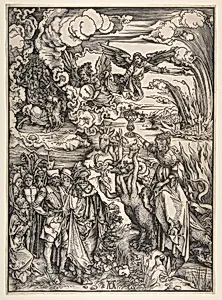
Medium
Woodcut
Dimensions
sheet, 15-5/8 x 11-1/4 in. (39.5 x 28.6 cm)
Classification
Prints
Department
Drawings and Prints
Museum
Metropolitan Museum of Art, New York, NY
Credit
Rogers Fund, 1918
Accession Number
18.65.8
Rights
Public Domain
Tags
Art Historical Context
Albrecht Dürer's *The Whore of Babylon*, created in 1498 as part of his groundbreaking *Apocalypse* series, vividly captures a dramatic scene from the Book of Revelation in the Bible. This woodcut depicts the infamous figure astride a monstrous seven-headed beast, surrounded by figures symbolizing doom and divine judgment—evident in the tags of men, women, apocalypse, and monsters. Printed on a sheet measuring 15-5/8 x 11-1/4 inches, it draws from the vivid prophecies of St. John, portraying the Whore as a richly dressed woman embodying corruption and excess, a potent symbol in late medieval Christian thought. As a master of the Northern Renaissance, Dürer revolutionized woodcut printmaking with his extraordinary technical precision. Unlike earlier crude blocks, his cuts achieve fine lines, intricate textures, and dynamic compositions, making complex biblical narratives accessible to a wide audience through affordable prints. The *Apocalypse* series, Dürer's first major independent project, was a commercial triumph, reflecting the era's fascination with end-times prophecies amid political and religious upheaval. Housed in the Metropolitan Museum of Art's Drawings and Prints department (Rogers Fund, 1918), this work showcases Dürer's blend of artistry and evangelism, influencing generations of printmakers and remaining a cornerstone of Renaissance graphic art. Visitors will marvel at its enduring power to evoke awe and introspection.
About the Artist
Albrecht Dürer · 1471–1528
Albrecht Dürer (1471–1528) stands as the preeminent figure of the Northern Renaissance and arguably the most influential artist in the history of printmaking. Born in Nuremberg on May 21, 1471, and dying in the same city on April 6, 1528, Dürer revolutionized the status of the artist in Northern Europe, transforming printmaking from a commercial craft into an independent fine art and establishing ...