
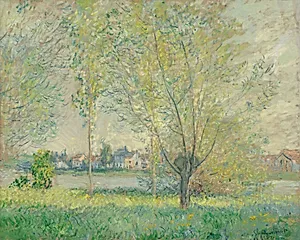
The Willows
1880
Medium
oil on canvas
Dimensions
overall: 66.68 × 81.92 cm (26 1/4 × 32 1/4 in.) framed: 90.49 × 106.05 × 9.53 cm (35 5/8 × 41 3/4 × 3 3/4 in.)
Classification
Painting
Department
CF
Museum
National Gallery of Art, Washington, D.C.
Credit
Corcoran Collection (Edward C. and Mary Walker Collection)
Accession Number
2015.19.65
Rights
Public Domain
Art Historical Context
Claude Monet's *The Willows* (1880), an oil on canvas measuring 66.68 × 81.92 cm, captures the of the French countryside with the artist's signature Impressionist touch. Painted during a pivotal moment in Monet's career, this work reflects his fascination with natural light and atmosphere, likely depicting gracefully drooping willow trees along a riverbank—a motif that recurs in his landscapes of the late 1870s and early 1880s. As a founding figure of Impressionism, Monet revolutionized painting by working en plein air, using loose, dappled brushstrokes to convey the transient play of sunlight on leaves and water rather than precise details. The medium of oil on canvas allowed him to layer vibrant colors and build luminous effects, breaking from academic traditions and emphasizing perception over realism. This piece exemplifies how Impressionists challenged the art world, prioritizing everyday scenes over grand historical subjects. Now part of the National Gallery of Art's Corcoran Collection (from Edward C. and Mary Walker), *The Willows* invites visitors to immerse in Monet's world, where nature's subtle beauty sparks joy and wonder. A testament to his enduring influence, it reminds us how a simple landscape can redefine artistic vision.
About the Artist
Claude Monet · 1840–1926
Claude Monet, born Oscar-Claude Monet on November 14, 1840, in Paris and raised in Le Havre, Normandy, began his artistic journey as a successful teenage caricaturist. His formal training started at the Le Havre secondary school of the arts in 1851, where he received his first drawing lessons from Jacques-François Ochard. Around 1858, he met Eugène Boudin, who became his pivotal mentor, introducin...