
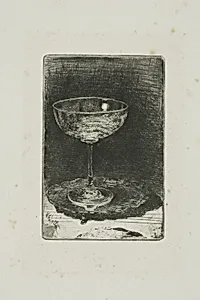
The Wine Glass
Medium
Etching with foul biting in black ink on ivory laid paper
Dimensions
Plate: 8.3 × 5.5 cm (3 5/16 × 2 3/16 in.); Sheet: 18.6 × 16 cm (7 3/8 × 6 5/16 in.)
Classification
etching
Department
Prints and Drawings
Museum
Art Institute of Chicago
Accession Number
109168
Rights
Public Domain
Art Historical Context
James McNeill Whistler’s *The Wine Glass* (1859) captures the quiet elegance of everyday objects through the intimate medium of etching. Created during Whistler’s formative years in Paris, where he immersed himself in the realist circles of artists like Gustave Courbet, this small plate (just 8.3 × 5.5 cm) exemplifies his early mastery of printmaking. Housed in the Art Institute of Chicago’s Prints and Drawings department, it invites viewers to appreciate the subtle beauty in simplicity—a hallmark of Whistler’s emerging Aesthetic movement philosophy, where “art for art’s sake” prioritized harmony and tone over narrative. The artwork’s technique is particularly noteworthy: an etching in black ink on ivory laid paper, enhanced by “foul biting.” This refers to unintended acid corrosion on the metal plate, which Whistler cleverly incorporated to create rich, textured tonal effects and atmospheric depth. Far from a flaw, it adds a sense of organic spontaneity to the precise lines defining the wine glass’s delicate stem and bowl. Whistler produced this during his “Thames Set” phase, a series of etchings documenting urban life, though this still life stands out for its refined minimalism. As one of Whistler’s pioneering prints from the 1850s etching revival, *The Wine Glass* highlights his innovative approach to translating painting’s subtlety into multiples, making fine art accessible. Its modest sheet size (18.6 × 16 cm) belies its cultural impact, influencing later Symbolists and modernists in celebrating the poetic mundane.
About the Artist
James McNeill Whistler · 1834–1903
James Abbott McNeill Whistler (1834-1903) was an American-born painter and printmaker who became a leading figure in the Aesthetic Movement and pioneer of Tonalism and Japonisme. He revolutionized art by championing "art for art's sake" and treating paintings as visual equivalents of musical compositions, titling works as "arrangements," "harmonies," and "nocturnes" to emphasize formal qualities o...