
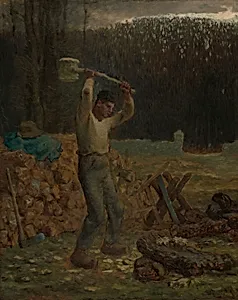
The Woodchopper
c. 1858–66
Medium
Oil on canvas
Dimensions
81 × 65 cm (31 7/8 × 25 9/16 in.); Framed: 99.1 × 83.8 cm (39 × 33 in.)
Classification
painting
Department
Painting and Sculpture of Europe
Museum
Art Institute of Chicago
Accession Number
81521
Rights
Public Domain
Art Historical Context
Jean-François Millet, a central figure of the Barbizon School and French Realism, painted "The Woodchopper" around 1858–66. During this time, he focused on scenes of rural labor, presenting peasants and farmworkers with quiet dignity rather than idealization. Created in the decades following the 1848 revolutions, the canvas captures a moment when industrialization was transforming European society, yet Millet chose to honor the enduring rhythms of the countryside. Executed in oil on canvas, the work allows for rich tonal contrasts and tactile surfaces that convey the weight of physical effort and the surrounding landscape. Millet’s approach rejected the polished finish of academic painting in favor of direct observation and earthy palettes, giving everyday subjects a monumental presence within a modest format of roughly 81 by 65 centimeters. Today at the Art Institute of Chicago, "The Woodchopper" invites viewers to consider the artist’s belief that honest labor held profound cultural value. The painting stands as a testament to Realism’s power to elevate the ordinary and remind us of humanity’s deep connection to the land.