
The Working Mother
Medium
Engraving
Dimensions
Sheet: 14 7/16 × 9 15/16 in. (36.7 × 25.3 cm)
Classification
Prints
Department
Drawings and Prints
Museum
Metropolitan Museum of Art, New York, NY
Credit
Harris Brisbane Dick Fund, 1953
Accession Number
53.600.527
Rights
Public Domain
Tags
Art Historical Context
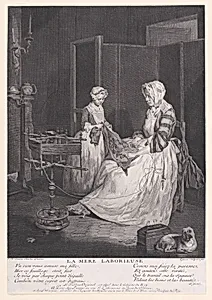
**The Working Mother** (1740) is a delicate engraving after a painting by Jean Siméonardin, the celebrated French Rococo master known for his intimate portrayals of everyday life. by engravers Bernard Lepicié Louis Surugue, published by Chez L'A, this print captures a tender domestic scene: a mother and young girl engaged in needlework within a cozy interior, accompanied by a loyal dog. Chardin's subtle realism—marked by soft lighting, textured fabrics, and quiet emotion—elevates ordinary moments into poetic vignettes, reflecting 18th-century bourgeois values of family and diligence. Engravings like this one were revolutionary in the 1740s, transforming Chardin's oil paintings into affordable reproductions that brought fine art into middle-class homes across Europe. Measuring 14 7/16 × 9 15/16 inches, its intricate lines masterfully mimic the painter's brushstrokes, preserving details like the gleam on sewing tools and the dog's watchful gaze. Housed in the Metropolitan Museum of Art's Drawings and Prints department (Harris Brisbane Dick Fund, 1953), it exemplifies how printmaking democratized art. This work highlights women's roles in the domestic sphere, blending maternal instruction with quiet productivity—a cultural touchstone of pre-Industrial France. Visitors will appreciate its warmth, inviting reflection on timeless family bonds.
About the Artist
Chez L'Auteur|Jean Siméon Chardin|Bernard Lepicié|Louis Surugue (French|French|French|French) · |1699 |1686 |1698 – |1779 |1762 |1755
|French, Paris 1699–1779 Paris|French, Paris ca. 1686–1762 Grand Vaux|French, Paris 1698–1755 Paris