
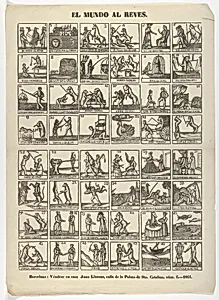
The world upside down ('El Mundo al Reves')
1861
Medium
Wood engraving
Dimensions
Sheet: 17 1/4 × 12 1/2 in. (43.8 × 31.7 cm)
Classification
Prints
Department
Drawings and Prints
Museum
Metropolitan Museum of Art, New York, NY
Credit
Max G. Wildnauer Fund, 1978
Accession Number
1978.643.27(2)
Rights
Public Domain
Tags
Art Historical Context
In the bustling world of 19th-centurymaking, Juan Llorens' *The World Upside Down (El Mundo al Revés)* (1861) captures a delightfully chaotic through the meticulous art of wood engraving. This Spanish artist's sheet-sized print (17¼ × 12½ in.) depicts an inverted universe teeming with human figures, animals, birds, fish, and even carriages tumbling in absurd harmony. Wood engraving, a technique where fine lines are incised into end-grain wood blocks for sharp, detailed reproduction, allowed Llorens to create intricate vignettes ideal for satire and mass dissemination in newspapers or broadsheets. The title evokes the "world turned upside down" trope, a popular motif in European caricature from the Renaissance onward, often used to lampoon social hierarchies or political disorder. Created amid Spain's turbulent 1860s—marked by unrest under Queen Isabella II—Llorens' work likely pokes fun at everyday absurdities, blending whimsy with subtle critique. Fish might swim through air, birds pull carriages, and humans cavort with beasts, inviting viewers to question norms. Housed in the Metropolitan Museum of Art's Drawings and Prints department (acquired via the Max G. Wildnauer Fund in 1978), this engraving exemplifies how affordable prints democratized art, sparking laughter and reflection for diverse audiences. A playful reminder that sometimes, flipping perspectives reveals hidden truths!