
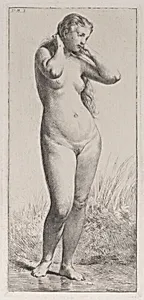
The Young Bather
Medium
Etching
Dimensions
Sheet: 18 7/8 × 12 3/16 in. (48 × 31 cm) Plate: 6 7/8 × 3 3/8 in. (17.5 × 8.5 cm)
Classification
Prints
Department
Drawings and Prints
Museum
Metropolitan Museum of Art, New York, NY
Credit
The Elisha Whittelsey Collection, The Elisha Whittelsey Fund, 1962
Accession Number
62.625.419
Rights
Public Domain
Tags
Art Historical Context
**The Young Bather1843)** is a etching collaboratively produced by French artists Charles Jacque and Auguste Delâtre. Jacque, a prominent printmaker known for his realistic depictions of rural life and animals in the Barbizon tradition, here turns his hand to the intimate subject of a female nude. Delâtre, a skilled master printer, likely contributed his expertise in refining the etched plate. Created during the early years of France's Romantic era transitioning toward Realism, the work captures a serene bathing scene, evoking classical themes of vulnerability and natural beauty amid the era's growing fascination with the female form. Etching, the medium of choice, involves coating a metal plate with acid-resistant ground, scratching designs into it, and immersing it in acid to etch lines of varying depth. This technique allowed Jacque to achieve intricate details and subtle tonal gradations on the modest plate (6 7/8 × 3 3/8 in.), which, when printed, fits elegantly on a larger sheet. Prints like this were affordable ways to disseminate artistic nudes, bridging elite salons and broader audiences in 19th-century Paris. Housed in the Metropolitan Museum of Art's Drawings and Prints department as part of The Elisha Whittelsey Collection (acquired 1962), *The Young Bather* exemplifies mid-19th-century printmaking's technical innovation and cultural allure. Visitors will appreciate its poised elegance, a window into how artists like Jacque explored sensuality through precise, reproducible art.