
The Young Shepherd, first plate
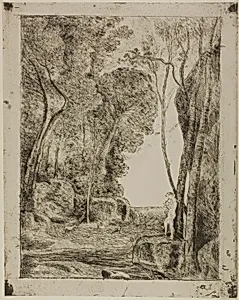
Medium
Cliché-verre on ivory photographic paper
Dimensions
Image: 32.4 × 24.7 cm (12 13/16 × 9 3/4 in.); Sheet: 36.2 × 28.7 cm (14 5/16 × 11 5/16 in.)
Classification
cliché-verre
Department
Prints and Drawings
Museum
Art Institute of Chicago
Accession Number
92313
Rights
Public Domain
Art Historical Context
Step into the serene world of Jean-Baptiste Camille Corot's *The Young Shepherd, first plate* (1855), a captivating example of the artist's foray into experimentalmaking. Corot, a leading figure in the Barbizon school, was renowned for his luminous landscapes and poetic figures that bridged Neoclassicism and Impression. Here, he depicts a youthful shepherd in a pastoral setting, evoking the timeless tranquility of rural life that defined much of his oeuvre. This work is a *cliché-verre*, a rare 19th-century technique where the artist draws directly on a glass plate with ink or paint, then contact-prints it onto photographic paper—like the ivory stock used here (image: 32.4 × 24.7 cm). Invented in the 1830s, *cliché-verre* fascinated painters like Corot during photography's early days, blending the spontaneity of drawing with the precision of light-sensitive chemistry. Produced around 1855, when such hybrids were avant-garde, this print from the Art Institute of Chicago's Prints and Drawings collection showcases Corot's innovative spirit. Its historical significance lies in bridging fine art and emerging photography, offering a window into mid-century artistic experimentation. Gaze upon the soft tonal gradations and delicate lines, and you'll sense Corot's masterful touch transforming a simple shepherd into an emblem of quiet elegance.