
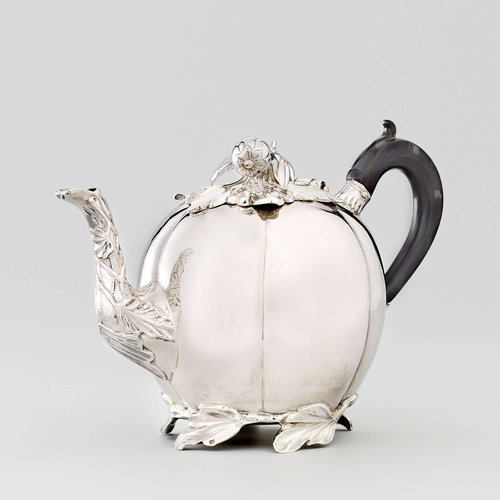
Theepot, meloenvormig
1778 - 1779
Medium
casting
Dimensions
13; 10.3; 8.9; 18.3
Rights
Public Domain
About this artwork
town mark
Art Historical Context
Behold the elegant "Theepot, meloenvormig" (Melon-Shaped Teapot), crafted Dutch silversmith Willem Schiff between 1778 and 1779. Standing at a modest height of 13 cm with a width of 18.3 cm, this delicate piece exemplifies the refined metalwork of the late 18th century. Its organic, melon-inspired form—smooth and bulbous—captures the playful naturalism popular in European decorative arts during the waning Rococo era, blending functionality with sculptural charm. Forged through the skilled technique of casting, the teapot showcases the precision of silversmithing, where molten metal is poured into molds to create seamless, durable forms. The presence of a town mark—a hallmark denoting the assay office of its origin, likely Amsterdam—underscores its authenticity and adherence to strict guild standards, ensuring purity and quality for discerning collectors. In the context of 18th-century Netherlands, this teapot reflects the rising popularity of tea culture among the bourgeoisie, symbolizing hospitality and sophistication. Schiff's work contributes to a rich tradition of Dutch silver, where everyday objects became miniature masterpieces, inviting us to appreciate the artistry in the domestic sphere.