
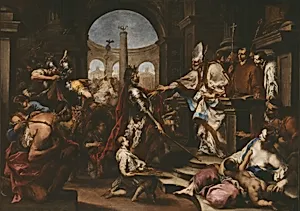
Theodosius Repulsed from the Church by Saint Ambrose
c. 1705
Medium
Oil on canvas
Dimensions
155.3 × 213.5 cm (61 1/8 × 84 1/16 in.); Framed: 189.9 × 248.3 cm (74 3/4 × 97 3/4 in.)
Classification
oil on canvas
Department
Painting and Sculpture of Europe
Museum
Art Institute of Chicago
Accession Number
12891
Rights
Public Domain
About this artwork
This painting depicts a historical event from the year 390 when Ambrose, the archbishop of Milan, refused to give communion to Emperor Theodosius I until he made public penance for the massacre of thousands of innocents after an insurrection. Theodosius, the last emperor to command the entire Roman Empire, eventually submitted to the archbishop’s moral authority. The brushwork and arrangement of figures in this composition showcase Alessandro Magnasco’s fluid, energetic style. However, for the ...
Art Historical Context
In the grand tradition of Baroque history painting, Alessandro Magnasco *Theodosius Rep from the Church by Saint* (c. 1705) captures a pivotal clash between imperial power and ecclesiastical authority. scene depicts the 4th-century Roman Emperor Theodosius I denied entry to Milan Cathedral by Bishop Saint Ambrose, who excommunicated him for ordering a brutal massacre in Thessalonica. This moment symbolizes the growing influence of the Christian Church over secular rulers, a theme resonant in Magnasco's era amid Counter-Reformation tensions. Magnasco, a masterful Italian late-Baroque artist from Genoa, infuses the oil-on-canvas work with his signature tenebrist style—dramatic chiaroscuro lighting that casts flickering shadows over a throng of figures, creating an atmosphere of tension and mysticism. At over six feet tall and seven feet wide, the canvas envelops viewers in its theatrical composition, blending historical drama with Magnasco's penchant for crowded, almost fantastical scenes often featuring monks and ruins. This large-scale format, typical of 18th-century Italian altarpieces or salon pieces, underscores its role in inspiring awe and moral reflection. Housed in the Art Institute of Chicago's European Painting and Sculpture department, this evocative masterpiece invites us to ponder enduring questions of justice and repentance, its shadowy drama as compelling today as in Magnasco's time.
About the Artist
Alessandro Magnasco · 1667–1749
Comment on works: Religious