
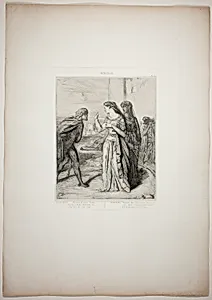
Therefore be merry, Cassio, plate six from Othello
Medium
Etching, engraving, roulette, and drypoint on paper
Dimensions
Image: 26.8 × 21.5 cm (10 9/16 × 8 1/2 in.); Plate: 31.8 × 24.5 cm (12 9/16 × 9 11/16 in.); Approx. sheet: 63.8 × 44.5 cm (25 1/8 × 17 9/16 in.)
Classification
etching
Department
Prints and Drawings
Museum
Art Institute of Chicago
Accession Number
129415
Rights
Public Domain
Art Historical Context
In the dimly lit halls of the Art Institute of's Prints and Drawings department Théodore Chassériau *Therefore be merry, Cass, plate six from Othello* (1844) captures a pivotal moment from Shakespeare's tragedy. This etching draws from Act 2, Scene 3, where Iago slyly encourages the drunken Cassio to revel, sowing seeds of jealousy and downfall. At just 25, the French Romantic artist Chassériau—pupil of Ingres and rival to Delacroix—created this as part of a rare series of 12 prints illustrating the play, blending literary drama with 19th-century passion for Shakespearean themes. Chassériau masterfully combines etching, engraving, roulette, and drypoint on paper, achieving rich tonal contrasts and velvety textures. The roulette adds subtle grainy effects for atmosphere, while drypoint's soft, burr-edged lines infuse figures with emotional intensity—Cassio's merry abandon contrasting Othello's looming fate. Measuring 26.8 × 21.5 cm, the intimate image exemplifies Romantic printmaking's expressive potential, bridging painting's drama with the precision of intaglio. This work highlights Chassériau's versatility amid France's Romantic fervor, where Shakespeare inspired visual reinterpretations. A gem for print enthusiasts, it invites visitors to ponder how one fateful toast unravels destinies, echoing timeless themes of deception and revelry.
About the Artist
Théodore Chassériau · 1819–1856
Théodore Chassériau was born on September 20, 1819, in El Limón, Samaná, in the Spanish colony of Santo Domingo — present-day Dominican Republic — to a French father and a Creole mother. The family relocated to Paris in 1820, and the young Chassériau's exceptional talent was evident almost immediately. At just eleven years old, in 1830, he was accepted into the prestigious studio of Jean-Auguste-D...