
Third Frontispiece
1876
Medium
Drypoint
Dimensions
sheet: 15 1/16 x 11 1/4 in. (38.2 x 28.6 cm) plate: 10 5/8 x 6 15/16 in. (27 x 17.6 cm)
Classification
Prints
Department
Drawings and Prints
Museum
Metropolitan Museum of Art, New York, NY
Credit
Gift of Bella C. Landauer, 1925
Accession Number
26.28.158
Rights
Public Domain
Tags
Art Historical Context
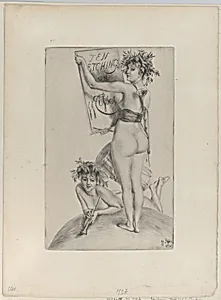
James Tissot's *Third Frontispiece*1876) is a striking drypoint print that captures the artist's mastery of intimate, evocative imagery. Created during Tissot's London exile following the Franco-Prussian War this work reflects his shift toward more personal and sensual subjects amid his renowned depictions of Victorian high society. As the "third" in a presumed series of frontispieces—title pages for books or print portfolios—it likely served as an alluring introduction, featuring female nudes that showcase Tissot's keen eye for graceful anatomy and subtle narrative tension. Drypoint, Tissot's chosen medium here, involves scratching directly into a copper plate with a sharp needle, raising a soft burr that holds ink for richly textured, velvety lines. This technique yields an immediacy and tonal depth unmatched by standard etching, allowing Tissot to blend precision with atmospheric softness. Measuring a modest plate size of 10 5/8 x 6 15/16 inches, the print invites close viewing, revealing the burr's delicate fuzziness that evokes skin's tactile allure. Housed in the Metropolitan Museum of Art's Drawings and Prints department since a 1925 gift from Bella C. Landauer, *Third Frontispiece* highlights Tissot's versatility beyond oil paintings. Its nude subject matter underscores 19th-century tensions between public propriety and private eroticism, offering visitors a window into the era's artistic boldness.
About the Artist
James Tissot · 1836–1902
James Tissot (1836–1902) was a French painter and printmaker who spent much of his career in England and became renowned for his meticulously detailed depictions of fashionable Victorian society. Born Jacques Joseph Tissot in Nantes, he studied at the École des Beaux-Arts in Paris under Louis Lamothe and Hippolyte Flandrin and exhibited at the Salon from 1859. Tissot's early career in Paris produ...