
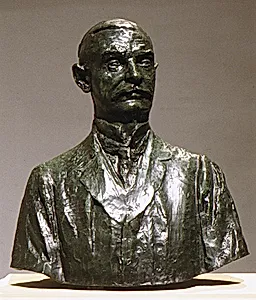
Thomas Fortune Ryan
modeled 1909
Medium
Bronze
Dimensions
Height: 23 in. (58.4 cm)
Classification
Sculpture-Bronze
Culture
French
Department
European Sculpture and Decorative Arts
Museum
Metropolitan Museum of Art, New York, NY
Credit
Gift of Auguste Rodin, 1911
Accession Number
11.174
Rights
Public Domain
Tags
Art Historical Context
Auguste Rodin's *Thomas Fortune Ryan* (modeled 1909) is a commanding bronze bust that captures the likeness and vigor of the American financier and philanthropist. Cast by the renowned Alexis Rudier, this23-inch sculpture exemplifies Rodin's late-career mastery in portraiture, where he transformed traditional busts into dynamic expressions of personality. The textured surface, with its deeply incised lines and dramatic modeling, conveys Ryan's intense gaze and robust features, reflecting Rodin's innovative approach to bronze as a medium that allowed for rich patinas and multiple editions. Created during Rodin's final years, when he was celebrated as the father of modern sculpture, this work bridges 19th-century realism with modernist fragmentation. Rodin, a French artist associated with Impressionism's influence on form and light, often portrayed intellectuals and patrons like Ryan, whom he met through cultural exchanges. The sculpture's gift directly from Rodin to the Metropolitan Museum of Art in 1911 underscores its prestige, entering the collection as a testament to transatlantic artistic ties. Housed in the Met's European Sculpture and Decorative Arts department, this piece invites visitors to ponder how Rodin immortalized industrial-era titans, blending psychological depth with sculptural vitality. A highlight for fans of portrait sculpture, it reveals the era's fusion of art, commerce, and legacy.
About the Artist
Auguste Rodin|Alexis Rudier · 1840–1917
François Auguste René Rodin (1840-1917) stands as the founder of modern sculpture, transforming the art form from academic tradition into expressive modernism. Born into a working-class Parisian family, Rodin faced early rejection, failing three times to gain admission to the prestigious École des Beaux-Arts. This setback forced him to work as a craftsman for nearly two decades, though his 1875 tr...