
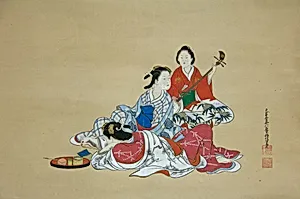
Three Beauties
18th century
Medium
Hanging scroll; ink and color on paper
Dimensions
Image: 14 1/4 in. × 21 in. (36.2 × 53.3 cm) Overall with mounting: 51 1/8 × 26 7/8 in. (129.9 × 68.3 cm) Overall with knobs: 51 1/8 × 29 1/4 in. (129.9 × 74.3 cm)
Classification
Paintings
Culture & Period
Japan · Edo period (1615–1868)
Department
Asian Art
Museum
Metropolitan Museum of Art, New York, NY
Credit
Charles Stewart Smith Collection, Gift of Mrs. Charles Stewart Smith, Charles Stewart Smith Jr., and Howard Caswell Smith, in memory of Charles Stewart Smith, 1914
Accession Number
14.76.42
Rights
Public Domain
Tags
Art Historical Context
"Three Beauties" is a captivating hanging scroll by Nishikawa Sukenobu, a prominent ukiyo-e of Japan's Edo period (1615–8). Created in the 18th century, ink and color on paper painting (14¼ × 21 in.) exemplifies the "floating world" genre, the elegance and leisure of beautiful women—bijin-ga. Here, three graceful figures engage with musical instruments, evoking the refined world of courtesans and urban pleasures in bustling Edo (modern Tokyo). Sukenobu's mastery shines in his delicate brushwork, blending soft ink lines with vibrant colors to convey poise and sensuality. Hanging scrolls like this were prized for intimate display in homes, unrolled for admiration during gatherings. They highlight Edo Japan's cultural flourishing, where art captured everyday joys amid strict social hierarchies. From the Metropolitan Museum of Art's Asian Art collection (Charles Stewart Smith Collection, 1914), this work offers a window into 18th-century Japanese aesthetics, blending artistry with the era's fascination for feminine beauty and music. A timeless treasure!
About the Artist
Nishikawa Sukenobu · 1671–1751
Japanese, 1671–1750