
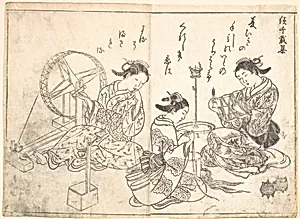
Three Courtesans Weaving Silk
Medium
Monochrome woodblock print; ink on paper
Dimensions
9 1/4 x 12 3/4 in. (23.5 x 32.4 cm)
Classification
Prints
Culture & Period
Japan · Edo period (1615–1868)
Department
Asian Art
Museum
Metropolitan Museum of Art, New York, NY
Credit
Gift of Mrs. Morris Manges, in memory of her husband, Dr. Morris Manges, 1947
Accession Number
JP3050
Rights
Public Domain
Tags
Art Historical Context
**Three Courtesans Weaving Silk** by Nishikawa Sukenobu is an elegant monochrome woodblock print from Japan's Edo period (1615–1868). Measuring just over 9 by 12 inches, this ink-on-paper work shows three courtesans absorbed in the skilled craft of weaving silk. Sukenobu, a Kyoto-based ukiyo-e artist renowned for bijin-ga (pictures of beautiful women), brought a gentle realism and graceful naturalism to his figures, distinguishing his style with careful attention to pose, costume, and everyday activity. During the Edo period's long peace and urban growth, woodblock prints made art widely accessible, capturing the "floating world" of fashion, entertainment, and daily life. Courtesans were frequent subjects, embodying both allure and the era's social complexities. By depicting them at work rather than in leisure, Sukenobu highlights the dignity of women's labor and traditional crafts like silk production. The monochrome technique emphasizes his masterful line work and balanced composition, drawing the eye to the women's focused gestures and the quiet harmony of the scene. This intimate print offers museum visitors a glimpse into both the technical artistry of ukiyo-e and the cultural world of Edo-period Japan, where beauty and industry often intertwined.
About the Artist
Nishikawa Sukenobu · 1671–1751
Japanese, 1671–1750