
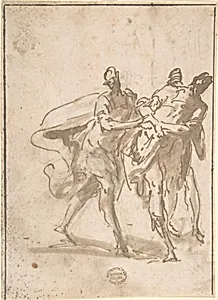
Three Figures (recto); Sketches of Kneeling Figures and Putti (verso)
1760–1806
Medium
Pen and brown ink, brush and brown wash, over black chalk on light brown paper (recto). Ruled framing outlines in pen and brown ink on left, top, and right edges. Black chalk, pen and brown ink (verso)
Dimensions
6 5/8 x 4 3/4in. (16.8 x 12.1cm)
Classification
Drawings
Department
Drawings and Prints
Museum
Metropolitan Museum of Art, New York, NY
Credit
Gift of Cornelius Vanderbilt, 1880
Accession Number
80.3.194
Rights
Public Domain
Tags
Art Historical Context
Domenico Mondo's *Three Figures (recto Sketches of Kneeling and Putti (vers)* is a delicate double-sided drawing from the late 18th century, the artist's skill as a Venetian draughtsman during a period bridging Rococo exuberance and emerging Neoclassicism. Created between 1760 and 1806—spanning Mondo's active years—this intimate sheet measures just 6⅝ × 4¾ inches, typical of sketchbook studies meant for personal use or workshop preparation. On the recto, three poised figures emerge through layered techniques: soft black chalk underdrawings define forms, refined by precise pen and brown ink lines, then modeled with fluid brush and brown wash for subtle volume and shadow. The verso features freer sketches of kneeling figures and playful putti (cherubic infants), using black chalk and ink, hinting at designs for frescoes or altarpieces common in Venetian ecclesiastical art. Ruled framing lines on three edges suggest it was once part of a bound album, emphasizing its utilitarian yet artistic purpose. A gift to the Metropolitan Museum of Art from Cornelius Vanderbilt in 1880, this work showcases the era's draftsmanship traditions, where such studies trained the hand and imagination. Visitors will appreciate its lively human forms—elegant and expressive—offering a window into the creative process of a lesser-known master of Venice's vibrant artistic scene.