
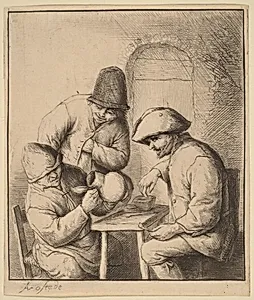
Three Peasants at an Inn, One Looking Down a Jug
c. 1648
Medium
etching, with touches of drypoint, on laid paper
Dimensions
sheet (trimmed to plate mark): 10.4 × 8.9 cm (4 1/8 × 3 1/2 in.)
Classification
Department
CG-E
Museum
National Gallery of Art, Washington, D.C.
Credit
Rosenwald Collection
Accession Number
1943.3.8295
Rights
Public Domain
Art Historical Context
Adriaen van Ostade, a Dutch Golden Age printmaker and painter, captures the earthy charm of everyday life in *Three Peasants at an, One Looking Down a* (c. 1648). This intimate etching depicts three rustic figures gathered at an inn, with one peering curiously into a jug—a humorous snapshot of peasant leisure amid the lively taverns of 17th Holland. Van Ostade, influenced by Rembrandt, excelled in genre scenes that celebrated the unpolished vitality of the lower classes, offering a window into the social fabric of the Dutch Republic during its prosperous era. Crafted as an etching with subtle drypoint touches on laid paper, the work measures just 10.4 × 8.9 cm, emphasizing its delicate, jewel-like scale. Etching allowed van Ostade's precise, expressive lines to convey texture—from weathered faces to the gleam of earthenware—while drypoint added velvety burrs for depth and warmth. This technique made his prints highly sought after, blending technical innovation with narrative appeal. Housed in the National Gallery of Art's Rosenwald Collection, this piece highlights van Ostade's mastery in elevating humble moments to art, inviting viewers to savor the simple joys and subtle wit of bygone rural life.
About the Artist
Adriaen van Ostade · 1610–1685
Adriaen Jansz. van Ostade (1610-1685) was a Dutch Baroque painter and printmaker who specialized in genre scenes of peasant life. Born and raised in Haarlem, he became one of the most prolific and celebrated artists of the Dutch Golden Age, producing over 800 paintings, 50 etchings, and numerous drawings. Van Ostade's significance in art history lies in his masterful depiction of peasant life, a ...