
明 文徵明、王守、王穀祥 行書、楷書詩 扇面|Three Poems
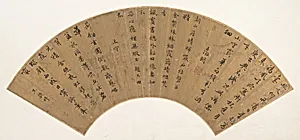
Medium
Folding fan mounted as an album leaf; ink on gold-flecked paper
Dimensions
6 3/8 x 20 1/4 in. (16.2 x 51.4 cm)
Classification
Calligraphy
Culture & Period
China · Ming dynasty (1368–1644)
Department
Asian Art
Museum
Metropolitan Museum of Art, New York, NY
Credit
Bequest of John M. Crawford Jr., 1988
Accession Number
1989.363.62
Rights
Public Domain
Art Historical Context
This exquisite folding fan, now mounted as an album leaf, showcases the collaborative genius of three Ming dynasty masters: Wen Zhengming, Shou, and Wang Guxiang. Titled *Three Poems*, it features calligraphy in running script (xingshu) and standard (kaishu), rendered in ink on shimmering gold-flecked paper Measuring just 6⅜ × 20¼ inches, its compact form originally suited the intimate, portable nature of fans—everyday objects transformed into treasures by literati artists during China's Ming period (1368–1644). Wen Zhengming, a leading figure of the Wu School, was renowned for his refined, poetic brushwork that blended painting and calligraphy, while Wang Shou and Wang Guxiang complemented him with their own masterful styles. The mix of fluid, expressive running script and the precise, upright standard script highlights the versatility of Chinese calligraphy, where each stroke conveys rhythm, emotion, and scholarly virtue. Such joint works symbolized deep friendships among elites, who often exchanged inscribed fans as gifts. In Ming culture, calligraphy on fans bridged art and poetry, capturing philosophical musings amid the era's flourishing literati tradition. Donated to the Metropolitan Museum of Art through the bequest of John M. Crawford Jr. in 1988, this piece invites us to appreciate how everyday luxuries became enduring emblems of refinement and harmony.
About the Artist
Wang Shou|Wang Guxiang|Wen Zhengming (Chinese|Chinese|Chinese) · 1400 |1501 |1470 –1449 |1568 |1559
Chinese, active first half of the 15th century|Chinese, 1501–1568|Chinese, 1470–1559