
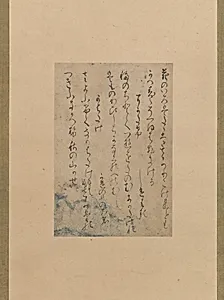
伝藤原行成筆 「荒木切」『古今和歌集』|Three Poems from the Collection of Poems Ancient and Modern (Kokin wakashū), one of the Araki Fragments (Araki-gire)
11th century
Medium
Page from a booklet mounted as a hanging scroll; ink on paper
Dimensions
Image: 8 in. × 5 3/8 in. (20.3 × 13.7 cm) Overall with mounting: 49 3/4 × 14 3/16 in. (126.3 × 36 cm) Overall with knobs: 49 3/4 × 15 7/8 in. (126.3 × 40.3 cm)
Classification
Calligraphy
Culture & Period
Japan · Heian period (ca. 900–1185)
Department
Asian Art
Museum
Metropolitan Museum of Art, New York, NY
Credit
Mary Griggs Burke Collection, Gift of the Mary and Jackson Burke Foundation, 2015
Accession Number
2015.300.230
Rights
Public Domain
Tags
Art Historical Context
This exquisite fragment showcases the calligraphy of Fujiwara no Yukinari (–1045), known as Kō, one of the Heian period's supreme masters of the brush. Titled *Three Poems from the Collection Poems Ancient and Modern (okin wakashū)*, it forms part of the renowned Araki-gire, or Araki Fragments—surviving pages from an early 11th-century of Japan's first imperial waka poetry anthology, compiled in 905 under Emperor Daigo. During the Heian era (ca. 900–1185), courtly culture flourished in Kyoto, where waka poems—evocative verses of 31 syllables—captured fleeting emotions, seasons, and love, often exchanged among aristocrats. Yukinari's script exemplifies the elegant *wayō* style, blending Chinese influences with a distinctly Japanese fluidity. Rendered in ink on delicate paper from a booklet, the three poems flow with rhythmic grace, their varying line thicknesses and subtle spacing conveying poetic nuance and emotional depth. Originally bound in a volume, this 8 x 5⅜-inch page has been remounted as a hanging scroll, a common practice to preserve and display such treasures. Housed in the Metropolitan Museum of Art's Mary Griggs Burke Collection, this work highlights calligraphy's status as a high art in Heian Japan, rivaling painting in prestige. It invites viewers to savor not just words, but the calligrapher's breath-like touch, bridging poetry and visual poetry across centuries.