
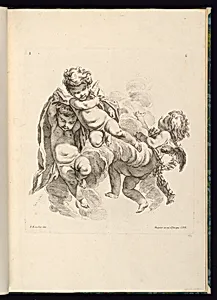
Three Putti
Medium
Classification
Department
Smithsonian Collection
Museum
Smithsonian American Art Museum
Credit
Purchased for the Museum by the Advisory Council
Accession Number
1921-6-247-12
Rights
Public Domain
About this artwork
Research in Progress
Art Historical Context
**Three Putti** François Boucher (1703–1770), a master of French Rococo art, created this charming print between 1738 and 1749, during the height of his career as a painter to King Louis XV. Boucher was for his lighthearted, decorative scenes filled with mythological whimsy, pastel colors, and figures. Putti—playful, winged cherubs derived from classical antiquity—were a favorite motif in his work, symbolizing love,, and the joys of earthly pleasures. This piece captures the Rococo spirit of elegance and delight, evoking the opulent world of 18th-century French aristocracy. As a print, *Three Putti* exemplifies the era's innovative reproductive techniques, likely an engraving or etching that allowed Boucher's designs to reach a wider audience beyond elite patrons. Prints democratized art, making high-style imagery accessible for homes, fans, and decorative objects. Housed in the Smithsonian American Art Museum's collection—purchased by the Advisory Council—this work highlights the transatlantic appeal of European Rococo, blending French finesse with American collecting tastes. Though research continues, *Three Putti* invites visitors to revel in Boucher's masterful blend of fantasy and sensuality, a window into the lavish Age of Enlightenment. (198 words)