
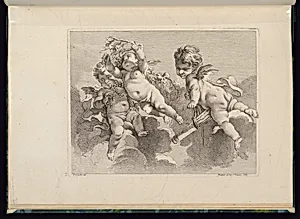
Three Putti
Medium
Classification
Department
Smithsonian Collection
Museum
Smithsonian American Art Museum
Credit
Purchased for the Museum by the Advisory Council
Accession Number
1921-6-247-24
Rights
Public Domain
About this artwork
Research in Progress
Art Historical Context
François Boucher, a leading figure of the French Rococo style, created *Three Putti* between 1738 and 1749. This charming print captures the artist's signature playful exuberance, featuring three plump, winged cherubs—known as putti—who frolic in a lighthearted tableau. Rococo art, flourishing under Louis XV's court, emphasized ornate decoration, sensuality, and mythological whimsy, and Boucher excelled at evoking these with his fluid lines and delicate shading. As a print, likely an etching or engraving after one of Boucher's designs, the work highlights the era's innovative reproductive techniques. Prints democratized high art, allowing Boucher's elegant motifs to grace homes beyond elite salons and inspire decorative arts like tapestries and porcelain. Acquired by the Smithsonian American Art Museum through its Advisory Council, it reflects the enduring appeal of 18th-century French mastery. Though research continues, *Three Putti* embodies Rococo's joyful escapism, a brief respite from Enlightenment rigor, inviting viewers to delight in its timeless innocence.