
Three Trees, Hoboken
Asher Brown Durand, ca. 1834
About this artwork
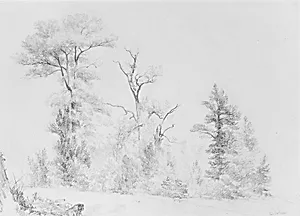
Asher B. Durand's *Three Trees, Hoboken* (ca. 1834) captures the rugged beauty of New Jersey's waterfront landscape in a delicate graphite drawing on yellowish buff-colored wove. Created during a pivotal moment in American art, when Durand was transitioning from engraving to landscape painting, this work reflects his deep commitment to direct observation of nature. Hoboken, just across the Hudson River from New York City, served as a prime sketching ground for artists seeking unspoiled wilderness amid rapid urbanization. The precisely rendered trees—likely oaks or elms—demonstrate Durand's mastery of graphite, using subtle shading and fine lines to convey texture, form, and atmospheric depth on the warm-toned paper. Measuring 9 9/16 x 13 1/2 inches, this intimate study exemplifies the preparatory sketches that informed his later oil paintings, embodying the Hudson River School's emphasis on truthful, detailed representations of the American sublime. Housed in The Metropolitan Museum of Art's American Wing, this piece, gifted by Nathan Chaikin in 1961, highlights early 19th-century shifts toward national identity through nature. Visitors will appreciate how Durand's meticulous eye laid the groundwork for an enduring tradition of landscape art celebrating America's wild heritage.