
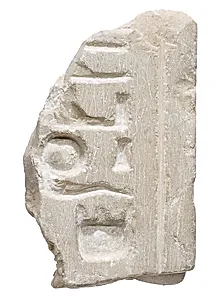
Throne fragment with inscription referring to king and queen
Unknown Artist
ca. 1353–1336 B.C.
Medium
Indurated limestone
Dimensions
Inscribed side to front: H. 6.2 × W. 3.7 × D. 2.8 cm (2 7/16 × 1 7/16 × 1 1/8 in.); Decorative border W. 2.2 cm
Classification
Throne fragment, inscription
Period
New Kingdom, Amarna Period
Department
Egyptian Art
Museum
Metropolitan Museum of Art, New York, NY
Credit
Gift of Edward S. Harkness, 1921
Accession Number
21.9.556
Rights
Public Domain
Art Historical Context
This delicate fragment from a royal throne, carved in indurated limestone—a durable, hardened stone favored by ancient Egyptian artisans—dates to Egypt's New Kingdom, around 1353–1336 B.C. Measuring just 6.2 cm high, it once adorned a seat of power during the Amarna Period of Dynasty 18, a era marked by radical artistic and religious innovations under pharaoh Akhenaten rule. The inscribed front and decorative border evoke the grandeur of palace furniture, where such pieces symbolized divine kingship. The inscription, a key feature, references a king and queen, highlighting their pivotal roles in Amarna's courtly life and ideology. Precision-carved hieroglyphs and ornate borders showcase the era's distinctive style: elongated forms, naturalism, and Aten sun-disk motifs that broke from rigid traditions. Though small, this throne remnant offers a tangible link to royal intimacy and propaganda. Gifted to the Metropolitan Museum of Art in 1921 by Edward S. Harkness, it invites us to ponder the lives of Egypt's enigmatic rulers amid revolutionary change. A testament to enduring craftsmanship, it whispers of thrones where history was made.