
Tile
Unknown Artist
1640–60
Medium
Tin-glazed earthenware
Dimensions
Overall: 5 × 5 in. (12.7 × 12.7 cm)
Classification
Ceramics-Pottery
Culture
Dutch
Department
European Sculpture and Decorative Arts
Museum
Metropolitan Museum of Art, New York, NY
Credit
Gift of W. R. Valentiner, 1908
Accession Number
08.196.46
Rights
Public Domain
Tags
Art Historical Context
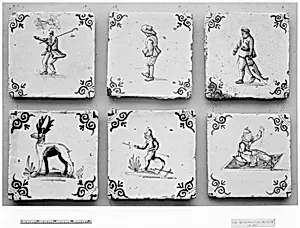
This charming 5 x 5-inch square tile, crafted in tin-glazed earthenware around 1640–60, hails from the Dutch Golden Age—a prosperous era when the Netherlands led in trade, art, and innovation. Produced by an unknown artisan, it likely depicts men and deer, evoking scenes of hunting or rural life that were popular motifs in Dutch decorative arts. These small-scale ceramics were mass-produced in workshops like those in Delft, transforming humble earthenware into glossy, durable panels through tin-glazing: a technique where a tin-oxide coating created an opaque white surface ideal for vibrant painted designs, often in blue monochrome. Tin-glazed tiles held immense cultural importance in 17th-century Dutch homes, adorning fireplaces, kitchens, and walls to protect against soot while adding artistic flair. They reflected everyday aspirations amid the era's wealth from global commerce, blending functionality with subtle storytelling—here, perhaps celebrating the thrill of the hunt. Gifted to the Metropolitan Museum of Art in 1908 by W.R. Valentiner, this piece exemplifies the exquisite craftsmanship of European decorative arts, inviting us to imagine it as part of a grand interior tableau. (198 words)