
Tile
Unknown Artist
ca. 1640–60
Medium
Tin-glazed earthenware
Dimensions
Overall: 5 × 5 × 1/2 in. (12.7 × 12.7 × 1.3 cm)
Classification
Ceramics-Pottery
Culture
Dutch, Delft
Department
European Sculpture and Decorative Arts
Museum
Metropolitan Museum of Art, New York, NY
Credit
Fletcher Fund, 1927
Accession Number
27.199.11
Rights
Public Domain
Tags
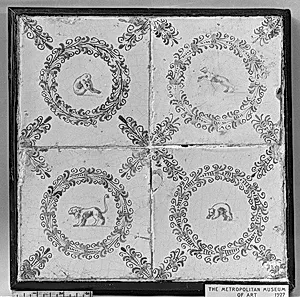
Art Historical Context
This charming 5-inch square tile, crafted in Delft, Netherlands, around 1640–60, exemplifies the Dutch Golden Age's mastery of tin-glazed earthenware, known as Delftware. Produced in factories like those in Delft, these tiles were fired earthenware coated with a white tin-opacified glaze, allowing vibrant painted designs in cobalt blue—imitating prized Chinese porcelain at a fraction of the cost. Mass-produced yet exquisitely detailed, they adorned the walls of prosperous Dutch homes, kitchens, and fireplaces, offering both decoration and practical moisture resistance. The tile's motifs—playful bears, majestic lions, and blooming flowers—reflect the era's fascination with nature, heraldry, and exoticism. Lions, symbols of strength and the Dutch Republic's coat of arms, paired with bears (perhaps evoking folklore or trade imports), frame delicate floral sprays in a symmetrical composition. This blue-and-white palette, inspired by Ming dynasty imports, showcases the painter's skill in layered washes for depth and shading. Acquired by The Metropolitan Museum of Art through the Fletcher Fund in 1927, this tile invites us into 17th-century Dutch life, where everyday ceramics became canvases for cultural pride and artistic innovation. A testament to Delft's global influence, it highlights how humble objects captured the spirit of a thriving maritime empire.