
Tile
Unknown Artist
ca. 1600
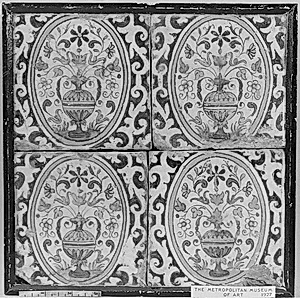
Medium
Tin-glazed earthenware
Dimensions
Overall: 5 1/4 × 5 1/4 × 5/8 in. (13.3 × 13.3 × 1.6 cm)
Classification
Ceramics-Pottery
Culture
Dutch
Department
European Sculpture and Decorative Arts
Museum
Metropolitan Museum of Art, New York, NY
Credit
Fletcher Fund, 1927
Accession Number
27.199.180
Rights
Public Domain
Tags
Art Historical Context
This charming Dutch tile, crafted around 1600 from tin-glazed earthenware exemplifies the artistry of the Netherlands' Golden Age. Measuring a modest 5¼ × 5¼ inches, it features delicate floral motifs—a popular theme in Dutch decorative arts that celebrated the era's fascination with nature's beauty. The tin-glaze technique, borrowed from Italian maiolica but perfected in Dutch workshops like those in Delft, created a smooth, white surface ideal for vibrant painted designs, mimicking the sheen of costly Chinese porcelain at a fraction of the cost. Produced during a boom in tile manufacturing, these squares were mass-made yet meticulously hand-painted, transforming ordinary homes into elegant spaces. Installed in vast panels on walls, fireplaces, or floors, they protected surfaces while adding artistic flair to daily life. This tile's survival highlights the durability of earthenware and the cultural value placed on affordable luxury. Now in the Metropolitan Museum of Art's European Sculpture and Decorative Arts collection (acquired via the Fletcher Fund in 1927), it offers a glimpse into 17th-century domestic refinement, where even humble ceramics embodied Dutch ingenuity and aesthetic sensibility.