
Tile
ca. 1900–14
Medium
Earthenware
Dimensions
8 1/4 x 8 3/8 x 13/16 in. (21 x 21.3 x 2.1 cm)
Classification
Tile
Culture
American
Department
The American Wing
Museum
Metropolitan Museum of Art, New York, NY
Credit
Gift of Robert A. Ellison Jr., 2018
Accession Number
2018.294.271
Rights
Public Domain
Tags
Art Historical Context
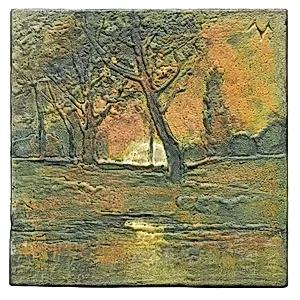
This exquisite earthenware tile by Charles Volkmar, created around 1900–1914, captures essence of American Arts and Crafts pottery. Measuring just over 8 inches square, it exemplifies Volkmar's mastery of low-fired earthenware, a medium prized for its warm, earthy tones and subtle glazes that mimicked natural stone. As a key figure in New York's pottery scene, Volkmar founded his own studio after training in Europe and Japan, blending Western techniques with Eastern influences to produce tiles for architectural decoration in homes and public spaces. The tile's landscape motif reflects the Arts and Crafts movement's reverence for nature, a reaction against industrialization. Volkmar's designs often featured serene vistas—rolling hills, trees, or watery scenes—rendered in soft, impressionistic glazes that invited viewers to pause and appreciate the handmade beauty. These tiles were not mere ornaments but functional art, enhancing fireplaces, fountains, and walls during America's Gilded Age transition to modernism. Housed in The Met's American Wing and gifted by Robert A. Ellison Jr. in 2018, this piece highlights the enduring appeal of Volkmar's work, bridging fine art and everyday life. It's a testament to how early 20th-century American artisans elevated ceramics to celebrate simplicity and craftsmanship.
About the Artist
Charles Volkmar · 1841–1914
American, Baltimore, Maryland 1841–1914 Metuchen, New Jersey