
Tile
Unknown Artist
late 16th–early 17th century
Medium
Artificial paste; painted and glazed
Dimensions
H. 9 1/16 in. (23 cm) W. 9 1/16 in. (23 cm) Th. 3/4 in. (1.9 cm)
Classification
Ceramics-Tiles
Department
Islamic Art
Museum
Metropolitan Museum of Art, New York, NY
Credit
Rogers Fund, 1970
Accession Number
1970.14
Rights
Public Domain
Tags
Art Historical Context
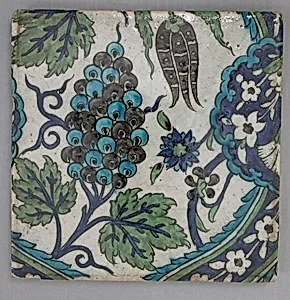
This exquisite square tile, crafted in the late 16th to early 17th century hails from the vibrant world of Islamic. Made of artificial paste—a composite material like fritware that allowed artisans to create durable, porcelain-like ceramics—it measures a neat 9 inches square and features a painted and glazed surface adorned with grapes. These lush clusters evoke abundance and the paradisiacal motifs common in Islamic decorative traditions, where fruit imagery symbolized fertility and divine bounty without direct references to wine. In Islamic architecture, such tiles were essential for adorning mosques, palaces, and madrasas, forming intricate mosaic panels that shimmered under light. The painting technique, applied under a transparent glaze before firing, ensured vivid colors and longevity, showcasing the period's mastery of low-fired ceramics in regions like Persia or the Ottoman Empire. Though the artist remains unknown, this piece reflects the anonymous yet highly skilled workshops that produced thousands for grand architectural schemes. Today, acquired through the Rogers Fund in 1970, it graces the Metropolitan Museum of Art's Islamic Art collection, inviting visitors to ponder the enduring beauty of everyday materials transformed into art. Imagine it as part of a vast wall, grapes cascading in eternal harvest.