
Tile
1771–76 (?)
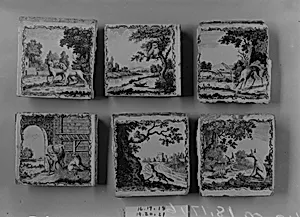
Medium
Earthenware, transfer-printed
Dimensions
4 1/2 x 4 1/2 in. (11.4 x 11.4 cm)
Classification
Tile
Culture
British
Department
The American Wing
Museum
Metropolitan Museum of Art, New York, NY
Credit
Rogers Fund, 1943
Accession Number
43.59.19
Rights
Public Domain
Tags
Art Historical Context
This delightful square tile, crafted by British potter Guy Green around 177–76, exemplifies the artistry of 18th-century earthenware. Measuring just 4½ x 4½ inches, it features transfer-printed designs of owls, cows, deer, foxes—lively pastoral motifs that evoke the English countryside. Transfer-printing, a revolutionary technique pioneered in Britain during the mid-1700s, allowed potters like Green to apply intricate engravings onto ceramics affordably, transforming everyday objects into accessible decorations for homes and fireplaces. Green, active in Liverpool's thriving pottery scene, helped popularize these small-scale tiles as affordable wall or hearth adornments. The earthy red tones of the earthenware body paired with crisp black transfers create a charming, folk-art feel, reflecting the era's fascination with nature and hunting imagery. Though its exact date is uncertain, this piece captures the height of British ceramic innovation just before the Industrial Revolution scaled up production. Housed in The Metropolitan Museum of Art's American Wing and acquired through the Rogers Fund in 1943, the tile hints at transatlantic exchanges, as such British wares were widely imported and admired in colonial America. A tiny window into everyday elegance!