
Tile
1771–76 (?)
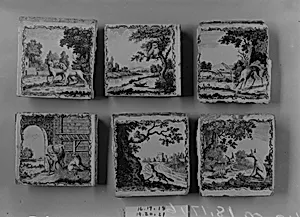
Medium
Earthenware, transfer-printed
Dimensions
4 1/2 x 4 1/2 in. (11.4 x 11.4 cm)
Classification
Tile
Culture
British
Department
The American Wing
Museum
Metropolitan Museum of Art, New York, NY
Credit
Rogers Fund, 1943
Accession Number
43.59.20
Rights
Public Domain
Tags
Art Historical Context
This charming square tile, crafted by British potter Guy Green around 1771–, exemplifies the innovative world of 18th-century ceramics. Measuring just 4½ x 4½ inches, it's of earthenware decorated with transfer-printing—a groundbreaking technique perfected in Liverpool, England, in the mid-1700s. This method involved printing designs onto tissue paper, then transferring them onto unglazed clay before firing, enabling affordable, high-quality mass production of intricate patterns. Featuring motifs of animals and landscapes ( suggested by its tags), the tile likely captures pastoral scenes popular in British decorative arts of the era—think serene countryside vistas with grazing livestock or wildlife. These small-scale wonders were staples in fireplaces, hearths, and wall panels, bringing artistry into everyday homes. Green's work from this period reflects the height of Liverpool tile production, which boomed during the Industrial Revolution. Housed in The Metropolitan Museum of Art's American Wing and acquired via the Rogers Fund in 1943, this British gem highlights transatlantic trade links. Colonial Americans imported thousands of such tiles, adorning their interiors with European flair. A delightful snapshot of craftsmanship meeting utility, it invites us to appreciate how humble objects shaped domestic life.