
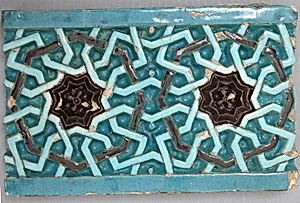
Tile Decorated with Entrelacs Pattern Based on Octagons
Unknown Artist
second half 14th century
Medium
Stonepaste; carved and glazed in turquoise and aubergine
Classification
Ceramics-Tiles
Department
Islamic Art
Museum
Metropolitan Museum of Art, New York, NY
Credit
Purchase, Walter D. Binger Gift, 1972
Accession Number
1972.88
Rights
Public Domain
Art Historical Context
This exquisite tile from the second half of the 14 century showcases the mastery of Islamic ceramic artistry, featuring an intricate entrelacs pattern built around octagons. Crafted from stonepaste—a composite material of quartz, clay, and frit that allowed for exceptional hardness and a luminous glaze—the tile was carved in relief before being coated in vibrant turquoise and aub hues. These colors, evoking the natural beauty of lapis lazuli and eggplant tones, were fired to create a durable, shimmering surface ideal for architectural decoration. In the Islamic world of the late medieval period, such tiles adorned mosques, madrasas, and palaces, particularly in regions like Persia (modern Iran) and Syria. The entrelacs design, with its interlocking geometric motifs based on octagons, reflects the profound mathematical sophistication of Islamic artisans. Octagons, symbolizing harmony and the infinite, avoided figurative imagery in line with aniconic traditions, inviting viewers into a meditative contemplation of divine order. Acquired by the Metropolitan Museum of Art in 1972 through the Walter D. Binger Gift, this tile exemplifies the technical innovation of stonepaste ceramics, which revolutionized tile production by mimicking porcelain's translucency while withstanding harsh climates. A testament to anonymous craftsmanship, it transports us to the opulent interiors of the medieval Islamic world.