
Tile from a Frieze
Unknown Artist
second half 13th century
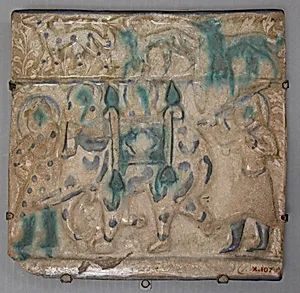
Medium
Stonepaste; overglaze luster-painted, molded
Dimensions
H. 10 7/8 in. (27.6 cm) W. 11 1/4 in. (28.6 cm)
Classification
Ceramics-Tiles
Department
Islamic Art
Museum
Metropolitan Museum of Art, New York, NY
Credit
Museum Accession
Accession Number
x.107
Rights
Public Domain
Tags
Art Historical Context
This exquisite tile from a frieze, crafted in the second half of the 13th century, hails from the vibrant world of Islamic ceramics. Measuring about 11 inches square, it features molded stonepaste— a fine, vitreous body developed in the Islamic world to mimic porcelain—with intricate overglaze luster-p that imparts a shimmering, metallic glow reminiscent of precious metals. Human figures, hinted at in its design, suggest it adorned a secular architectural setting, such as a palace or mosque mihrab, where such lively motifs flourished. Lusterware like this reached its zenith in 13th-century Syria and Iran, techniques perfected by artisans who applied metallic oxides over a glazed surface, then fired in a low-oxygen kiln to achieve iridescence. The molding added relief depth, allowing for dynamic storytelling through figures in motion. This tile exemplifies the technical innovation of Islamic potters, who exported their wares across Eurasia, influencing later European ceramics. As part of the Metropolitan Museum of Art's Islamic Art collection, it offers a window into medieval splendor, where art blended functionality with opulence, celebrating human form in a culturally nuanced way. Visitors, imagine it gleaming under lantern light in a grand hall!