
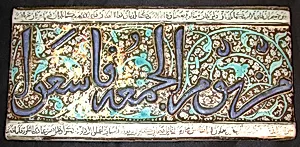
Tile from a Frieze
Unknown Artist
13th century
Medium
Stonepaste; inglaze painted in blue and turquoise and luster-painted on opaque white glaze
Dimensions
H. 7 1/2 in. (19.1 cm) W. 15 3/4 in. (40 cm) D: 1 3/4 in. (4.4 cm)
Classification
Ceramics-Tiles
Department
Islamic Art
Museum
Metropolitan Museum of Art, New York, NY
Credit
Museum Accession
Accession Number
x.111
Rights
Public Domain
Tags
Art Historical Context
This exquisite *Tile from a Frieze crafted in the 13th century, exemplifies the pinnacle of Islamic ceramic artistry. Made from stonepaste—a composite body of quartz, clay, and frit that mimics porcelain's translucency—the tile is adorned with inglaze painting in vibrant blue and turquoise, topped by shimmering luster on an opaque white glaze. 7½ by 15¾ inches, its elegant Arabic calligraphy likely formed part of a larger architectural band, evoking rhythm and spiritual harmony. In the medieval Islamic world, particularly in regions like Iran and Syria, such frieze tiles decorated the walls of mosques, madrasas, and palaces. The 13th century marked a golden age for lusterware techniques, inherited from Abbasid innovations and refined under Mongol influences, allowing artists to achieve metallic iridescence that caught the light in sacred spaces. Stonepaste's durability and fine detail enabled intricate designs without cracking during firing. The prominence of Arabic calligraphy underscores its cultural reverence as the art of the written word, often conveying Quranic verses or poetic blessings. This anonymous masterpiece invites us to ponder the unseen hands that elevated everyday architecture into divine poetry, a testament to Islam's aniconic aesthetic where script becomes the ultimate ornament.