
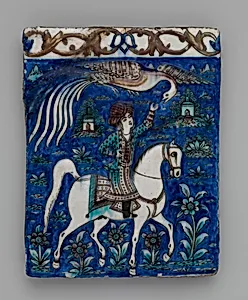
Tile with an Image of a Prince on Horseback
Unknown Artist
second half 19th century
Medium
Stonepaste; molded, polychrome painted under transparent glaze
Dimensions
H. 13 1/2 in. (34.3 cm) W. 10 3/4 in. (27.3 cm) D. Wt.
Classification
Ceramics-Tiles
Department
Islamic Art
Museum
Metropolitan Museum of Art, New York, NY
Credit
Bequest of George White Thorne, 1883
Accession Number
83.1.67
Rights
Public Domain
Tags
Art Historical Context
This stunning tile, depicting a prince astride a majestic horse amid birds and blooming flowers, exemplifies the vibrant ceramic artistry of the Islamic world in the second half of the19th century. Crafted from stonepaste—a composite of quartz, clay, and frit that allowed for fine detailing and durability—the tile was molded for subtle relief and adorned with polychrome paints fired under a transparent glaze. This underglaze technique, perfected in regions like Persia and the Ottoman Empire, ensured colors remained vivid and resistant to wear, making such pieces ideal for architectural decoration. In the Islamic artistic tradition, tiles like this one graced the walls of mosques, palaces, and private homes, transforming spaces into visual narratives of power and nature. The central prince, likely evoking royal hunts or heroic tales, reflects Qajar-era Persian influences, where equestrian figures symbolized nobility and vitality. Surrounding floral motifs and birds add layers of symbolism—flowers for paradise gardens, birds for spiritual freedom—blending realism with poetic idealism. Measuring 13½ by 10¾ inches, this tile entered the Metropolitan Museum of Art in 1883 via the bequest of George White Thorne. It invites visitors to imagine its original setting: a shimmering revetment alive with stories from a bygone era.