
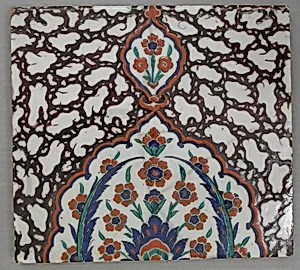
Tile with Floral Cartouche Design on Ebru (Marble Imitation Pattern) Background
Unknown Artist
late 16th century
Medium
Stonepaste; polychrome painted under transparent glaze
Dimensions
H. 12 1/8 in. (30.8 cm) W. 13 3/8 in. (34 cm) D. 7/8 in. (2.2 cm) Wt. 2lbs 10 oz (1190.8 g)
Classification
Ceramics-Tiles
Department
Islamic Art
Museum
Metropolitan Museum of Art, New York, NY
Credit
Gift of William B. Osgood Field, 1902
Accession Number
02.5.102
Rights
Public Domain
Tags
Art Historical Context
This exquisite tile, crafted in the late 16th century, hails from the Islamic world during the height of Ottoman artistic innovation. Featuring a central floral cartouche—a framed bouquet of blooming flowers—set against an intricate Ebru background mimicking the swirling, marble-like patterns of traditional Turkish marbled paper, it measures about 12 by 13 inches. Such tiles adorned mosques, palaces, and baths, transforming interiors into vibrant gardens that evoked paradise, a common theme in Islamic art where floral motifs symbolized renewal and divine beauty. The medium, stonepaste (a fine fritware body prized for its hardness and ability to hold vibrant glazes), is painted in polychrome under a transparent glaze—a technique perfected in Ottoman workshops, likely Iznik, Turkey. This underglaze method ensured colors remained vivid and unfaded over centuries, while the Ebru imitation added a luxurious, almost painterly depth, bridging paper arts and ceramics. Its subtle depth of nearly an inch and substantial weight highlight its architectural purpose. A gift to the Metropolitan Museum of Art in 1902, this anonymous masterpiece showcases the era's mastery of pattern and color, inviting visitors to ponder the seamless blend of utility and poetry in Islamic design.