
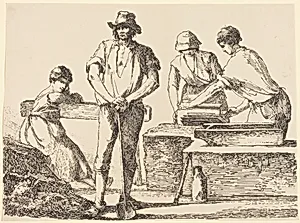
Tilemakers
1803
Medium
pen-and-tusche lithograph
Classification
Department
CG-E
Museum
National Gallery of Art, Washington, D.C.
Credit
Rosenwald Collection
Accession Number
1947.7.126
Rights
Public Domain
Art Historical Context
Thomas Barker's *Tilemakers* (1803) is a captivating pen-and-tusche lithograph that captures the everyday labor of artisans in early 19th-century Britain. Created just five years after Alois Senefelder's invention of lithography, this print showcases Barker's skill as a pioneering adopter of the medium. Working on specially prepared limestone with pen for crisp lines and tusche—a greasy, liquid medium—for soft tonal gradations, Barker produced an image rich in texture and detail, evoking the gritty rhythm of tile production. As "Barker of Bath," the artist was renowned for his Romantic genre scenes and landscapes, often infused with a sympathetic eye for working-class life during Britain's Industrial Revolution. *Tilemakers* reflects this interest, portraying the physical toil and camaraderie of craftsmen in a pre-mechanized era, when handmade tiles were essential for architecture and hearths. Its reproducibility via lithography marked a democratic shift in art, making high-quality images accessible beyond elite patrons. Housed in the National Gallery of Art's Rosenwald Collection (Department CG-E), this print exemplifies early graphic innovation. Visitors will appreciate its historical snapshot: a window into vanishing trades, preserved through Barker's masterful technique.