
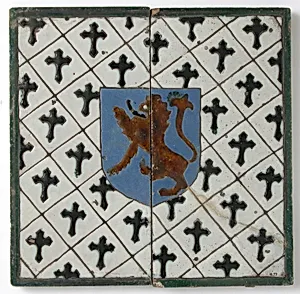
Tiles with a Lion on a Shield
Unknown Artist
late 1400s or early 1500s
Medium
Tin-glazed earthenware (cuerda seca technique)
Dimensions
Overall: 11 1/8 x 5 9/16 x 5/8 in. (28.3 x 14.1 x 1.6 cm)
Classification
Ceramics-Tiles
Culture
Spanish
Department
Medieval Art
Museum
Metropolitan Museum of Art, New York, NY
Credit
Rogers Fund, 1916
Accession Number
16.77a, b
Rights
Public Domain
Tags
Art Historical Context
Step into the vibrant world of late medieval Spanish ceramics with *Tiles with a Lion on a Shield*, crafted in the late 1400s or early 1500s. These striking tin-glazed earthenware tiles, measuring about 11 x 5 inches, showcase a bold coat of arms: a fierce lion rampant on a shield, symbolizing strength, nobility, and courage in heraldic tradition. Produced by an unknown artist, they exemplify the architectural splendor of Spain during the transition from the Middle Ages to the Renaissance, where such tiles adorned palaces, churches, and public buildings to display family crests or royal emblems. The cuerda seca technique is a highlight here—a masterful method where a "dry cord" of greasy manganese or beeswax outlined designs, preventing colorful glazes from bleeding into each other during firing. This created sharp, jewel-like contrasts in blues, golds, and whites on the earthenware base, making the tiles both durable for walls or floors and visually dazzling. Popular in Hispanic-Moresque workshops, especially in regions like Manises or Seville, cuerda seca blended Islamic ceramic ingenuity with Christian Iberian motifs, reflecting Spain's cultural fusion post-Reconquista. Today, these tiles from the Metropolitan Museum of Art's Medieval Art collection (acquired via the Rogers Fund in 1916) offer a glimpse into everyday heraldry. Imagine them gleaming under sunlight in a grand hall—timeless sentinels of Spanish pride and artistry.