
Time
ca. 1545–50
Medium
Engraving
Dimensions
plate: 3 1/16 x 2 7/8 in. (7.8 x 7.3 cm)
Classification
Prints
Department
Drawings and Prints
Museum
Metropolitan Museum of Art, New York, NY
Credit
The Elisha Whittelsey Collection, The Elisha Whittelsey Fund, 1949
Accession Number
49.97.374
Rights
Public Domain
Tags
Art Historical Context
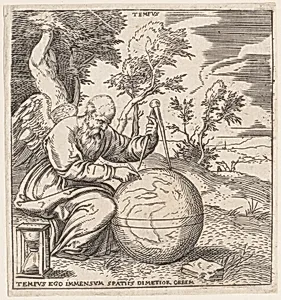
In the mid-16th century, engraver Enea V crafted *Time*, a delicate allegorical print (ca. 1545–50) that captures the Renaissance fascination with temporality and human mortality. This intimate engraving, measuring just 3 1/16 x 2 7/8 inches, depicts symbolic motifs like an hourglass—representing the fleeting sands of life—and globes, evoking the world's vastness and the inexorable passage of time.ico, a master of burin, was renowned for his precise reproductive prints that bridged painting and printmaking, making sophisticated imagery accessible to collectors across Europe. Engraving's significance here lies in its technical brilliance: Vico's fine lines create intricate shading and texture on copper plates, allowing for rich tonal depth in a tiny format. Produced during the Mannerist era, when artists like him emulated masters such as Parmigianino, this work reflects the period's intellectual curiosity about cosmology and philosophy, blending art with emblematic symbolism popular in emblem books. Today, housed in the Metropolitan Museum of Art's Drawings and Prints department (The Elisha Whittelsey Collection, 1949), *Time* invites visitors to ponder eternity in a glance— a timeless reminder that even the grandest globes turn with time's unyielding hand.
About the Artist
Enea Vico · 1523–1567
Enea Vico (1523–1567) was born in Parma and came of age during the final, energetic decades of Italian Renaissance printmaking. By 1541 he had made his way to Rome, where he entered the orbit of the engraver and publisher Tommaso Barlacchi and began his professional career. In Rome, Vico encountered the work of the most celebrated printmakers of the preceding generation—Marcantonio Raimondi, Agost...