
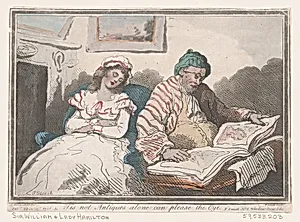
'Tis not Antiques Alone can Please the Eye, or Tastes Differ
November 20, 1786
Medium
Hand-colored etching
Dimensions
Sheet: 6 1/8 × 8 1/2 in. (15.6 × 21.6 cm)
Classification
Prints
Department
Drawings and Prints
Museum
Metropolitan Museum of Art, New York, NY
Credit
The Elisha Whittelsey Collection, The Elisha Whittelsey Fund, 1959
Accession Number
59.533.203
Rights
Public Domain
Tags
Art Historical Context
In the lively world of 18th-century British satire, Rowlandson, a master caricaturist, created *'Tis not Antiques can Please the Eye, Tastes Differ* on November 20, 6. This hand-colored etching, measuring just 6 1/8 × 8 1/2 inches, captures Rowlandson's signature wit through exaggerated figures and humorous vignettes. Produced during the Georgian era's boom in printmaking, such affordable etchings—enhanced by vibrant hand-coloring—were popular for poking fun at society's quirks, distributed widely in London shops. The title slyly contrasts the era's fascination with antiques and collecting—fueled by Grand Tour souvenirs and emerging antiquarianism—with more mundane pleasures. Tags hint at a scene of drowsy men and women, some nodding off while others read, suggesting boredom amid dusty relics. Rowlandson's loose, fluid lines and satirical edge highlight differing tastes, critiquing pretentious collectors while celebrating everyday follies. Housed in the Metropolitan Museum of Art's Drawings and Prints department (The Elisha Whittelsey Collection, 1959), this print exemplifies the hand-colored etching's role in democratizing art. It invites us to chuckle at human nature, reminding visitors that beauty, like taste, is delightfully subjective.
About the Artist
Thomas Rowlandson|T. Smith · 1756–1827
Thomas Rowlandson (1757–1827) was an English artist and caricaturist whose satirical watercolors and prints captured the social life of Georgian Britain with unparalleled wit and technical mastery. Alongside James Gillray, he is recognized as one of the greatest British graphic artists, and his distinctive flowing line and keen observations have made his work integral to understanding late 18th an...