
Titelbild (Title Page)
1923
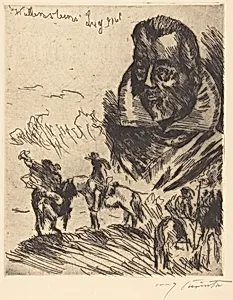
Medium
etching in black on laid paper
Dimensions
plate: 25.8 x 20.9 cm (10 3/16 x 8 1/4 in.) sheet: 40.2 x 29 cm (15 13/16 x 11 7/16 in.)
Classification
Department
CG-W
Museum
National Gallery of Art, Washington, D.C.
Credit
Gift of the Marcy Family in memory of Sigbert H. Marcy
Accession Number
1991.244.8
Rights
Public Domain
Art Historical Context
Lovis Corinth's *Titelbild (Title Page)*, created in 1923, is a striking etching that exemplifies the artist's late-career mastery of printmaking. By this time, Corinth—a leading German painter and printmaker who bridged Impressionism and Expressionism—was in his final years, having suffered strokes that infused his work with bold, emotive vigor. This intimate plate measures 25.8 x 20.9 cm, printed in black ink on laid paper, a traditional support with its characteristic ribbed texture that enhances the tactile quality of etchings. Etching allowed Corinth to achieve intricate, fluid lines through a meticulous process: he coated a copper plate with acid-resistant ground, scratched his design into it, and submerged it in acid to "bite" the lines. Inked and printed under pressure, the result is a rich interplay of light and shadow. As a "title page," it likely served as a frontispiece for a publication or portfolio, underscoring prints' role in democratizing art during the Weimar Republic's cultural ferment. Now housed in the National Gallery of Art's CG-W Department, this work was generously gifted by the Marcy Family in memory of Sigbert H. Marcy. It invites visitors to appreciate Corinth's technical prowess and the expressive power of black-and-white printmaking, a medium that captured the era's intensity with economical elegance.
About the Artist
Lovis Corinth · 1858–1925
Lovis Corinth, born Franz Heinrich Louis on July 21, 1858, in Tapiau, East Prussia (now Gvardeysk, Russia), to a tanner father, displayed prodigious drawing talent from childhood. He began formal training at the Königsberg Academy in 1876, then moved to the Academy of Fine Arts in Munich from 1880 to 1884, studying under Ludwig von Löfftz and briefly Franz von Defregger, where he absorbed a Realis...