
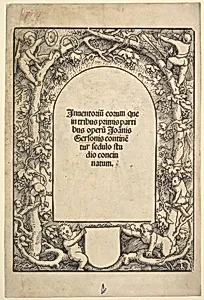
Title Border with Five Genii and a Monkey
Medium
Woodcut
Dimensions
Block: 9 5/8 × 7 3/16 in. (24.5 × 18.2 cm) Sheet: 11 9/16 × 7 11/16 in. (29.3 × 19.6 cm)
Classification
Prints
Department
Drawings and Prints
Museum
Metropolitan Museum of Art, New York, NY
Credit
The Elisha Whittelsey Collection, The Elisha Whittelsey Fund, 1959
Accession Number
59.570.29
Rights
Public Domain
Tags
Art Historical Context
Hans Baldung Grien, prominent German artist of the Northern Renaissance and a close associate of Albrecht Dürer, created *Title Border with Five Genii and a Monkey* 1510. This woodcut, measuring about 9⅝ × 7¼ inches on the block, exemplifies Baldung's mastery of printmaking during a time when woodcuts were revolutionizing the dissemination of art through books and broadsheets. Often used as ornamental frames for title pages, such borders blended whimsy with classical motifs, making fine art accessible beyond elite patrons. The composition features five playful genii—cherubic childlike figures inspired by Renaissance humanism—and a lively monkey clambering among them, adding a touch of earthy humor. Baldung's technique shines in the crisp, expressive lines carved into the wood block, allowing for subtle tonal variations when inked and printed. Monkeys, as seen in the tags, frequently symbolized curiosity or folly in Renaissance imagery, infusing the design with symbolic depth. Housed in the Metropolitan Museum of Art's Drawings and Prints department as part of The Elisha Whittelsey Collection, this work highlights the era's fusion of Gothic detail and emerging naturalism, inviting visitors to appreciate how everyday prints captured the imagination of 16th-century Europe.
About the Artist
Hans Baldung (called Hans Baldung Grien) · 1484–1545
Hans Baldung Grien (1484/85–1545), born in Schwäbisch Gmünd into an erudite family of jurists and physicians, forsook academia to pursue art. His early training around 1500 took place in the Upper Rhineland, likely Strasbourg, before he apprenticed under Albrecht Dürer in Nuremberg from 1503 to 1507. There, the young artist honed his skills in painting, printmaking, and stained glass, even managin...