
Title Page for "The Capricci"
c. 1617
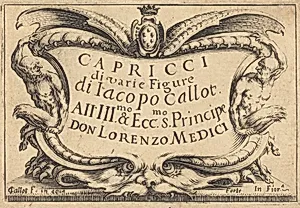
Medium
etching on laid paper
Dimensions
plate: 5.5 × 8.5 cm (2 3/16 × 3 3/8 in.) sheet: 6.5 × 9.4 cm (2 9/16 × 3 11/16 in.)
Classification
Department
CG-E
Museum
National Gallery of Art, Washington, D.C.
Credit
Rosenwald Collection
Accession Number
1949.5.97
Rights
Public Domain
Art Historical Context
Jacques Callot's *Title Page for "Theci"* (c. 1617) invites visitors into the whimsical world of one of the Baroque master's most inventive print series. This intimate etching on laid paper, measuring just 5.5 × 8.5 cm at the plate mark, serves as the grand entrance to *The Capricci*, a of fantastical figures blending humor, grotesquerie, and theatrical flair. Callot, pioneering French etcher who trained in Italy, drew inspiration from commedia dell'arte and carnival motifs, capturing the exuberant spirit of early 17th-century European culture. Renowned for refining the etching technique with exceptionally fine, fluid lines, Callot achieved remarkable detail in these diminutive formats—perfect for collectors and connoisseurs. The use of laid paper, with its characteristic chain lines, underscores the craftsmanship of period printmaking, allowing for precise ink transfer and tonal subtlety. This work exemplifies how prints democratized art, circulating imaginative designs across courts and workshops. Now part of the National Gallery of Art's Rosenwald Collection, this title page highlights Callot's enduring legacy in bridging painting and graphic arts, delighting us with its playful nod to human folly and creativity.
About the Artist
Jacques Callot · 1592–1635
Jacques Callot (1592–1635) was a French printmaker and draftsman from the Duchy of Lorraine, widely regarded as one of the first great artists to practice the graphic arts exclusively. His more than 1,400 etchings chronicled the breadth of 17th-century life, from Medici court festivities to the brutal realities of warfare. Callot revolutionized etching through technical innovations including the é...