
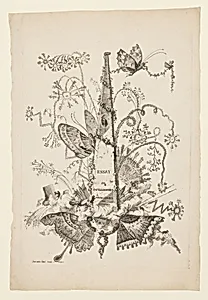
Title page from Essai de Papilloneries Humaines par Saint Aubin
ca. 1756–60
Medium
Etching; first state of two
Dimensions
plate: 12 13/16 x 9 5/16 in. (32.5 x 23.7 cm) sheet: 15 5/8 x 10 9/16 in. (39.7 x 26.8 cm)
Classification
Prints
Department
Drawings and Prints
Museum
Metropolitan Museum of Art, New York, NY
Credit
The Elisha Whittelsey Collection, The Elisha Whittelsey Fund and Rogers Fund, 1982
Accession Number
1982.1101.1
Rights
Public Domain
Tags
Art Historical Context
Step into the enchanting world of 18th-century Frenchoco art with this *Title page from Essai de Papillon Humaines par Saint Aubin* by Charles Germain de Saintubin, created around 1756–60. Saint-Aubin, a celebrated engraver and draftsman from a prominent artistic family, captures the era's delight in whimsy and nature through this etching—the first state of two, preserving its pristine lines before later alterations. Measuring about 12 13/16 x 9 5/16 inches on the plate, it exemplifies the precision of etching, a technique where acid bites into a metal plate to yield intricate, fluid details ideal for ornamental designs. The title, translating to "Essay on Human Butterflyeries," hints at a playful fusion of lepidoptera and human folly, adorned with motifs of butterflies and plants that evoke the period's fascination with natural history and satire. Rococo artists like Saint-Aubin often infused prints with lighthearted fantasy, blending scientific observation with decorative flair amid the opulent courts of Louis XV's France. Housed in the Metropolitan Museum of Art's Drawings and Prints department as part of The Elisha Whittelsey Collection, this rare first-state impression offers a window into Enlightenment-era printmaking innovation and cultural levity, where even insects danced in human guise.