
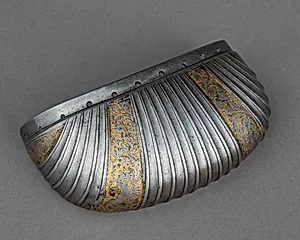
Toe Cap for a Foot Defense (Sabaton)
Unknown Artist
ca. 1510
Medium
Steel, gold
Dimensions
L. 2 3/8 in. (6 cm); W. 4 3/4 in. (12.1 cm)
Classification
Armor Parts
Culture
German
Department
Arms and Armor
Museum
Metropolitan Museum of Art, New York, NY
Credit
Gift of Stephen V. Grancsay, 1942
Accession Number
42.50.22
Rights
Public Domain
Art Historical Context
This exquisite toe cap for a sabaton, crafted around 1510 in Germany, represents a pinnacle of Renaissance armor-making. Sabatons were essential foot defenses in full plate armor, protecting knights' toes during mounted combat or foot tournaments. At just 2 3/8 inches long 4 3/4 inches wide, this steel piece highlights the precision engineering of German armorer workshops, where functionality met emerging artistic flair amid the Italian Wars and chivalric ideals. Forged from durable steel and adorned with gold—likely through gilding techniques—this component balanced battlefield resilience with opulent display. Gold accents signified the wearer's status, transforming armor from mere protection into a symbol of power and wealth. German armor from this era evolved toward lighter, more articulated designs, influencing European styles for centuries. Today, gifted to the Metropolitan Museum of Art by Stephen V. Grancsay in 1942, this rare artifact invites us to marvel at the unsung artistry of anonymous craftsmen, bridging medieval might with Renaissance refinement.