
Toleware Sugar Bowl
c. 1940
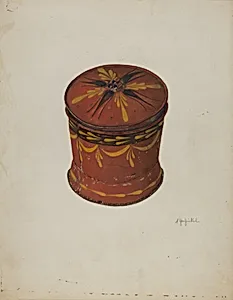
Medium
watercolor, graphite, and gouache on paperboard
Dimensions
overall: 29.1 x 22.9 cm (11 7/16 x 9 in.) Original IAD Object: 3 3/4" high; 4 3/16" in diameter
Classification
Index of American Design
Department
CG-W
Museum
National Gallery of Art, Washington, D.C.
Credit
Index of American Design
Accession Number
1943.8.15197
Rights
Public Domain
Art Historical Context
This delicate rendering captures a charming 19th-century toleware sugar bowl, crafted from painted tin. Created around 1940 by Sara Garfinkel as part of the Index of American Design, the uses watercolor, graphite, and gouache on paperboard to faithfully document the object’s modest size—roughly 3¾ inches high and 4⅛ inches in diameter—and its likely decorative motifs. Toleware, an affordable alternative to imported ceramics, became popular in American households for everyday items like sugar bowls. These tin pieces were often hand-painted with colorful flowers or stenciled patterns, reflecting both practicality and a desire for beauty in ordinary domestic life. Garfinkel’s illustration belongs to a larger federal project that recorded American decorative arts during the 1930s and 1940s, preserving visual records of objects that might otherwise have been lost. The careful layering of transparent washes and fine graphite lines highlights the bowl’s curved form and painted surface, demonstrating how the Index artists combined precision with artistic sensitivity. Today, this work at the National Gallery of Art invites viewers to appreciate both the humble ingenuity of early American metalwork and the meticulous craft of its 20th-century documentation.