
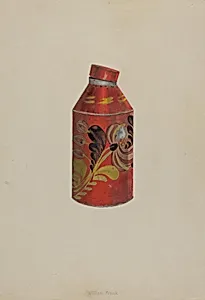
Toleware Tea Caddy
c. 1938
Medium
watercolor, gouache, and graphite on paperboard
Dimensions
overall: 35.5 x 24.2 cm (14 x 9 1/2 in.) Original IAD Object: 6 1/4" high; 2 3/4" wide
Classification
Index of American Design
Department
CG-W
Museum
National Gallery of Art, Washington, D.C.
Credit
Index of American Design
Accession Number
1943.8.15229
Rights
Public Domain
Art Historical Context
Discover the intricate beauty of *Toleware Tea Caddy*, a meticulously rendered watercolor, gouache, and graphite depiction by artist William Frank, created around 1938. This 35.5 x 24.2 cm work on paperboard captures a diminutive original object—measuring just 6 1/4 inches high and 2 3/4 inches wide—showcasing the delicate painted tinware typical of American folk art. Toleware, or japanned tin, was a popular 19th-century craft, where everyday metal items like tea caddies were adorned with vibrant enamels and lacquers, blending European techniques with American ingenuity for household elegance. Frank's piece is part of the prestigious Index of American Design, a Works Progress Administration (WPA) project from the 1930s that employed artists to document the nation's decorative arts heritage amid the Great Depression. Through precise layering of translucent watercolors, opaque gouache for bold colors, and graphite for fine details, these renderings preserved vanishing folk objects with photographic accuracy, celebrating everyday American craftsmanship. Housed in the National Gallery of Art's collection, this artwork highlights toleware's cultural role in colonial and early American homes, where tea caddies stored precious leaves as symbols of refinement. It invites visitors to appreciate how such humble designs embodied resourcefulness and artistic flair in shaping U.S. identity.