
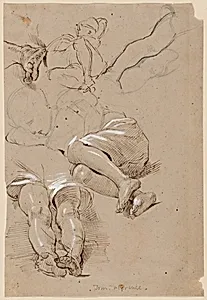
Tom -- Florence
1838
Medium
graphite, white gouache, and pen and brown ink on tan wove paper
Dimensions
sheet: 27.4 × 18.5 cm (10 13/16 × 7 5/16 in.) mount: 35.8 × 24.7 cm (14 1/8 × 9 3/4 in.)
Classification
Drawing
Department
CG-E
Museum
National Gallery of Art, Washington, D.C.
Credit
Joseph F. McCrindle Endowment Fund
Accession Number
2020.38.4
Rights
Public Domain
Art Historical Context
George Richmond's *Tom -- Florence* (1838) is a delicate drawing capturing a moment from the artist's formative years abroad. A key figure in Britain's early Victorian art scene, Richmond—friend to William Blake and later mentor to Pre-Raphaelite painters—traveled to Italy in the late 1830s to study Renaissance masters. Created in Florence, this intimate portrait likely reflects his immersion in the city's artistic heritage, blending observation with poetic sensitivity during a period of personal and stylistic growth. Executed on tan wove paper, the work masterfully combines graphite for subtle shading, pen and brown ink for precise contours, and white gouache for luminous highlights. This mixed-media technique, typical of 19th-century sketchbooks, allowed Richmond to achieve depth and vitality on a modest 27.4 × 18.5 cm sheet—perfect for travel studies. The warm tan ground enhances the modeling, evoking the soft light of Tuscany. Housed in the National Gallery of Art thanks to the Joseph F. McCrindle Endowment Fund, this drawing exemplifies Richmond's skill in portraiture and his bridge between Romanticism and emerging Pre-Raphaelite precision. It invites visitors to ponder the everyday muse—a figure named Tom—amid Florence's timeless inspiration.
About the Artist
George Richmond · 1809–1896
British, Brompton 1809–1896 London