
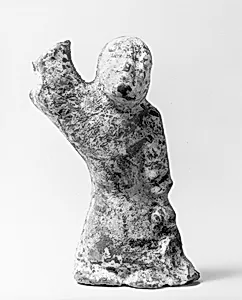
Tomb figure
Unknown Artist
Medium
Dark pottery with white slip and red paint
Dimensions
H. 3 in. (7.6 cm)
Classification
Tomb Pottery
Culture & Period
China · Han dynasty (206 B.C.–A.D. 220)
Department
Asian Art
Museum
Metropolitan Museum of Art, New York, NY
Credit
Fletcher Fund, 1936
Accession Number
36.12.15
Rights
Public Domain
Tags
Art Historical Context
This petite tomb figure, standing just 3 inches (7.6 cm) tall, exemplifies the Han dynasty's (206 B.C.–A.D. 220) rich tradition of funerary art from ancient China. Crafted from dark pottery coated with white slip and accented by red paint, it belongs to the class of mingqi—ceramic objects buried with the elite to serve them in the afterlife. Such figures, often depicting servants, attendants, or guardians, reflect the Han belief in an eternal spiritual realm mirroring earthly life. The artistic techniques highlight Han potters' skill: the dark clay body provided a sturdy base, while white slip created a smooth surface for intricate details, and red paint added vivid highlights to facial features, clothing, or accessories. This polychrome approach brought realism and vitality to these small-scale sculptures, making them lifelike companions for the deceased. Housed in the Metropolitan Museum of Art's Asian Art department (Fletcher Fund, 1936), this anonymous work offers a window into Han society's prosperity and spiritual worldview, where even the afterlife demanded practical help. A charming survivor of over two millennia, it invites us to ponder the enduring human desire for companionship beyond death.