
Torah crown (keter)
ca. 1740–50
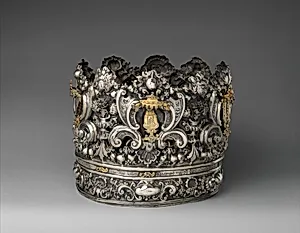
Medium
Silver, parcel gilt
Dimensions
Overall (confirmed, irregular diameter): 10 13/16 × 12 3/8 × 12 3/8 in. (27.5 × 31.4 × 31.4 cm)
Classification
Metalwork-Silver
Culture
Italian, Venice
Department
European Sculpture and Decorative Arts
Museum
Metropolitan Museum of Art, New York, NY
Credit
Director's Fund, 2013
Accession Number
2013.443
Rights
Public Domain
Tags
Art Historical Context
This exquisite Torah crown, or *keter*, crafted by silversmith Andrea Zamb "L'Honnesta" around 1740–50, exemplifies the opulent metalwork of 18th-century Venice. Fashion from silver and parcel-g—selectively gilded with gold for a luminous contrast—the crown measures about 10 13/16 × 12 3/8 × 12 3/8 inches, its irregular diameter designed to encircle a Torah scroll. Adorning synagogues, these crowns symbolize the Torah's regal importance, elevating the sacred text during rituals. Hailing from Venice's vibrant Jewish community—home to Europe's first ghetto since 1516—this piece reflects Italian Jewish artistry amid the Baroque-to-Rococo transition. Zambelli's workshop specialized in liturgical objects, blending intricate chasing, repoussé, and piercing techniques to create dynamic forms that catch the light, evoking divine splendor. Today, housed in the Metropolitan Museum of Art's European Sculpture and Decorative Arts department (acquired via the Director's Fund in 2013), it invites visitors to appreciate how Venetian craftsmanship bridged religious devotion and secular luxury, preserving a rich intercultural heritage.