
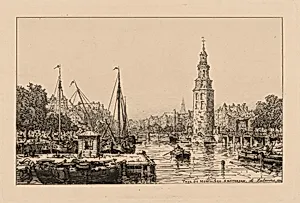
Tour de Montalban, Amsterdam
1884
Medium
etching on laid paper
Dimensions
image: 13.7 × 21.8 cm (5 3/8 × 8 9/16 in.) plate: 16 × 24 cm (6 5/16 × 9 7/16 in.) sheet: 24.8 × 35.4 cm (9 3/4 × 13 15/16 in.)
Classification
Department
CG-E
Museum
National Gallery of Art, Washington, D.C.
Credit
Gift of Carol and James Goodfriend
Accession Number
2021.113.55
Rights
Public Domain
Art Historical Context
Maxime Lalanne's *Tour de Montalban,* (1884) captures the iconic Montelbaanstoren a 16th-century tower in Amsterdam's harbor district, originally built as a guard tower and later adapted as a warehouse. This etching reflects Lalanne's fascination with European architecture during the late 19th-century Etching Revival, a movement that revived the intricate techniques of masters like Rembrandt. As a French artist (1827–1886), Lalanne was renowned for his precise renderings of urban scenes, blending Romantic detail with emerging Realist clarity. Printed on laid paper—a traditional handmade sheet with visible chain lines that enhance the tactile quality of etchings—the work measures a modest 13.7 × 21.8 cm for the image, inviting intimate viewing. Etching allowed Lalanne to achieve fine lines and rich tonal contrasts through acid-bitten copper plates, evoking the tower's weathered stone and bustling waterways with atmospheric depth. Housed in the National Gallery of Art's print collection (gift of Carol and James Goodfriend), this piece highlights cross-cultural artistic exchange, as a French etcher immortalized Dutch heritage. It offers visitors a window into 19th-century printmaking's golden age, where such works democratized fine art for collectors and enthusiasts alike.
About the Artist
Maxime Lalanne · 1827–1886
François Antoine Maxime Lalanne (1827–1886) was born in Bordeaux into a family of civil servants, initially pursuing classical studies and a law career. At the Institution Oré, he learned drawing from instructor Saulnier and showed early promise, exhibiting pencil and pastel works at Bordeaux's Philomathique Society in 1850, where he earned a bronze medal. Encouraged by architect Léo Drouyn, Lalan...